3-Month-Old Wake Windows: How Long Awake, and How Much Sleep
· 6 min read
How long should a 3-month-old be awake between naps?
A 3-month-old is usually awake for about 1 hour 30 minutes to 2 hours between sleeps, the average awake window in the guide from Tresillian, a free parenting service in Australia. Cleveland Clinic gives 1 hour 15 minutes to 2 hours 30 minutes for babies 3 to 4 months old, up from 1 to 2 hours at 1 to 3 months.
Both cover the whole time your baby is up: Cleveland Clinic counts from waking until you put them down to nap, and Tresillian includes the time taken to feed and play.
| Measure | Typical range | Source |
|---|---|---|
| Awake time between sleeps | 1 h 30 min to 2 h (3 months) | Tresillian |
| Awake time between sleeps | 1 to 2 h (1 to 3 months); 1 h 15 min to 2 h 30 min (3 to 4 months) | Cleveland Clinic |
| Total sleep in 24 hours, naps included | 14 to 17 h (0 to 3 months); 12 to 16 h (4 to 11 months) | WHO |
| Total sleep in 24 hours, naps included | 12 to 16 h (4 to 12 months); no figure under 4 months | AASM |
| Total sleep, parent reports | Average 14.4 h (3 months) | Finnish cohort study, 2020 |
| Number of naps | 2 to 3 (3 to 5 months); 3 to 4 (6 to 12 weeks) | Tresillian |
| Daytime naps in total | 3 to 4 h (3 to 5 months) | Tresillian |
| Night sleep, 7 p.m. to 7 a.m. | Average 9.1 h (3 months) | Finnish cohort study, 2020 |
| Longest night stretch | 4 to 5 h (6 to 12 weeks) | Tresillian |
| Sleep at night | 5 to 8 h or longer in some babies, not all (3 to 6 months) | NHS |
Wake windows lengthen as your baby grows: Tresillian gives an average of 2 to 3 hours for a 5-month-old. Cleveland Clinic notes that your baby's wake windows may look a little different from one day to the next, even from one nap to the next. Wake windows by age covers the rest of the first year.
How much should a 3-month-old sleep?
The World Health Organization (WHO) recommends 14 to 17 hours of good-quality sleep in 24 hours, naps included, for babies 0 to 3 months old. For babies 4 to 11 months, the WHO range is 12 to 16 hours.
The American Academy of Sleep Medicine (AASM), in a 2016 consensus the American Academy of Pediatrics endorsed, recommends 12 to 16 hours for babies 4 to 12 months, so a 3-month-old is just younger than the ages it covers. The AASM leaves younger babies out because of the wide range of normal variation in their sleep and too little evidence linking amounts to health outcomes, a gap covered in how much sleep a baby needs at each age.
What babies actually sleep varies widely. In a 2020 study published in Sleep Medicine, parents of 3-month-olds in one of two Finnish birth cohorts reported an average of 14.4 hours of sleep a day. The authors found the range very wide, particularly in early childhood, and put their average slightly above an earlier meta-analysis, which found 13.6 hours at three months.
How many naps does a 3-month-old take?
A 3-month-old typically takes 2 to 3 daytime naps in Tresillian's guide for 3 to 5 months, down from 3 to 4 at 6 to 12 weeks.
What tends to come next is covered in the four-month sleep change. For where and how to lay your baby down for naps, see safe sleep practices for infants.
How long should a 3-month-old nap?
Daytime naps add up to 3 to 4 hours in Tresillian's guide for 3 to 5 months, and how that splits varies: Tresillian says some babies have 2 to 3 longer sleeps a day while others only need short sleeps. Its example day suggests the mid-afternoon nap may only need to be short.
Parents in the Finnish study reported more daytime sleep at three months, an average of 5.3 hours. That study counted every sleep between 7 a.m. and 7 p.m. as daytime, a different measure from Tresillian's nap totals.
How long does a 3-month-old sleep at night?
About 9 hours between 7 p.m. and 7 a.m. on average, in parent reports from the 2020 Finnish study of 3-month-olds, which also found an average of 2.2 wakings between 10 p.m. and 6 a.m.
The longest single stretch varies. By 6 to 12 weeks, Tresillian's guide describes one sustained night sleep of 4 to 5 hours, with 1 to 3 brief wakings, and its guide for 3 to 5 months says night sleeps lengthen from there. The NHS says that from 3 to 6 months, some babies may sleep for 5 to 8 hours or longer at night, but not all.
Night feeds are still expected at this age: Tresillian says babies 3 to 5 months old are likely to be feeding every 3 to 5 hours, including at least 1 to 2 milk feeds overnight, and are not expected to sleep through the night for long periods until after 6 months. Cleveland Clinic puts it a little earlier: it describes sleeping through the night as five to six hours at a stretch without feeding, which most babies start by 6 months and some around 4 months.
What does a 3-month-old's sleep schedule look like?
A 3-month-old's day repeats a loop of feed, play and sleep in Tresillian's routine for 3 to 5 months, with each sleep following your baby's tired cues. Tresillian suggests keeping the three in the same sequence at the same time each day, and ends the day with an evening feed and quiet time, such as a bath and a cuddle, before settling for the night.
The NHS says a simple, soothing bedtime routine may help your baby settle, and suggests steps such as a bath, night clothes and a fresh diaper, dimmed lights and a goodnight cuddle. Cleveland Clinic suggests keeping the bedtime routine to 20 to 30 minutes.
Cleveland Clinic advises keeping naps as part of your baby's daytime routine, because a baby kept up longer in the hope of a better night becomes overtired and has a hard time falling and staying asleep. Tresillian calls its routine a guide only, to be adapted to your baby's sleep needs and your own activities, and says illness and busy days may throw off routines and awake windows, which is ok.
What are the signs a 3-month-old is tired?
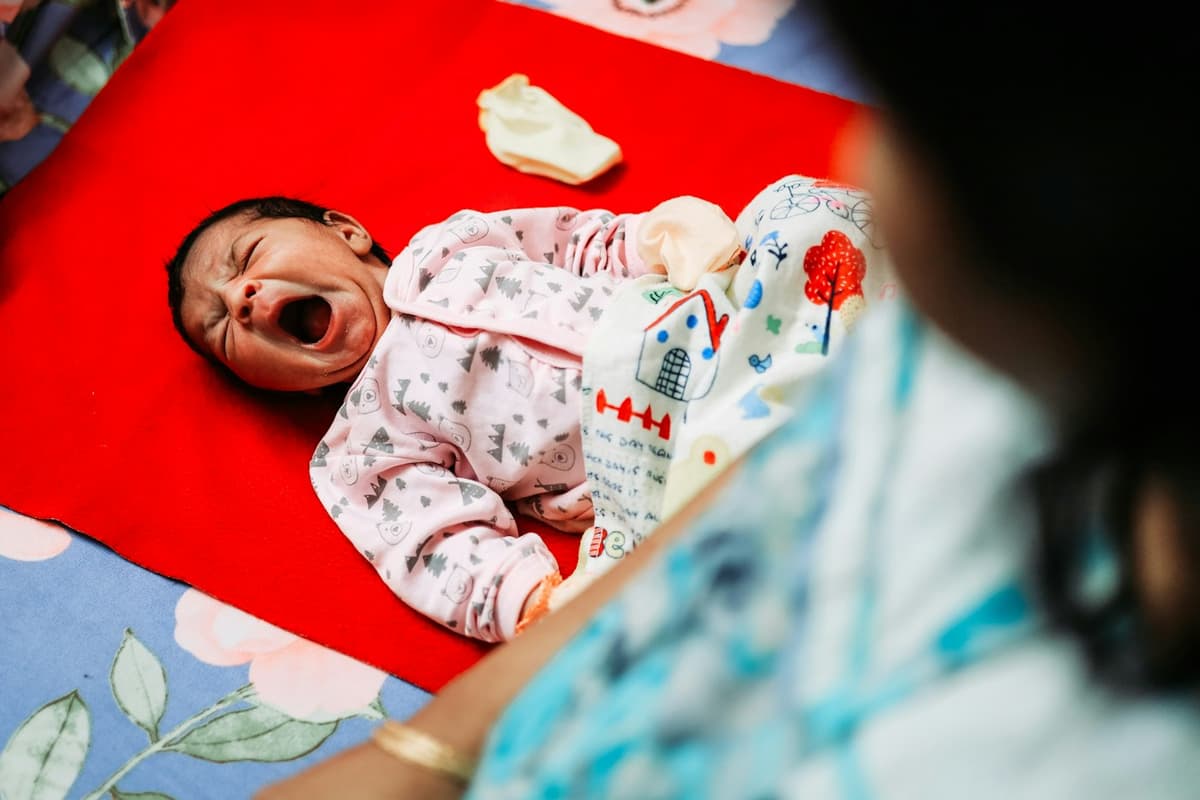
Common tired signs at 3 months include yawning, rubbing their eyes, face or ears, dull eyes and heavy lids, going quiet or seeming less alert, sucking or putting their hands to their mouth, and fussing or restlessness, in Tresillian's list for 3 to 5 months. Cleveland Clinic pediatrician Kristin Barrett, MD, adds blinking more often and staring off, and says activity level generally drops as a baby starts to get sleepy.
Tresillian suggests also thinking about how long ago your baby last fed and slept. If your baby is happy and interactive while awake, Tresillian says, they have likely had enough sleep.
Cleveland Clinic suggests noting when your baby's sleepy signs usually appear, and Dr. Barrett says the goal is to put them down for a nap when they're sleepy but still awake.
When should you call your pediatrician about sleep?
Cleveland Clinic advises talking to your pediatrician if your baby:
- Seems extremely fussy and soothing isn't working
- Has a hard time waking up
- Seems uninterested in feeding
The AASM says parents concerned that their child is sleeping too little or too much should consult their healthcare provider. Cleveland Clinic's advice for anything else is that when in doubt, call your pediatrician.
In the app: A baby sleep tracker that shows you the pattern
Official guidance
- Cleveland Clinic — What Are Baby Wake Windows? And How Long Should They Be?
- Tresillian — Baby Awake Windows & Routines 3 to 5 Months
- Tresillian — Newborn Sleep
- World Health Organization — To grow up healthy, children need to sit less and play more
- American Academy of Sleep Medicine — Recommended Amount of Sleep for Pediatric Populations: A Consensus Statement of the American Academy of Sleep Medicine
- Sleep Medicine — Normal sleep development in infants: findings from two large birth cohorts (Paavonen et al., 2020)
- NHS — Helping your baby to sleep
- Cleveland Clinic — When Do Babies Sleep Through the Night? Sleep in Your Baby's First Year
Written by The MyBaby editorial team. How we source and review these.
MyBaby is not a medical device and does not provide medical advice, diagnosis or treatment. Always consult a qualified healthcare professional with questions about your child's health.