How Many Wet Diapers Should a Newborn Have? Day-by-Day Counts and Colors
· Updated · 7 min read

How many wet diapers should a newborn have?
About 1 wet diaper on day 1, one more each day after that, and 6 or more heavy wet diapers a day from about day 5 or 6. Ireland's Health Service Executive (HSE) counts one wet diaper per day of life, from 1 on day 1 to 5 on day 5, then 6 or more a day from day 6 to 6 weeks. The NHS expects only 2 or 3 wet diapers in the first 48 hours, then at least 6 heavy, wet diapers every 24 hours from day 5 onward.
The American Academy of Pediatrics (AAP) sets the same endpoint: 6 or more wet diapers a day, with nearly colorless or pale yellow urine, by 5 to 7 days old. All three figures come from breastfeeding guidance. The table gives the HSE's day-by-day counts for a breastfed baby, and its last row is from Unicef UK's checklist for bottle-fed babies.
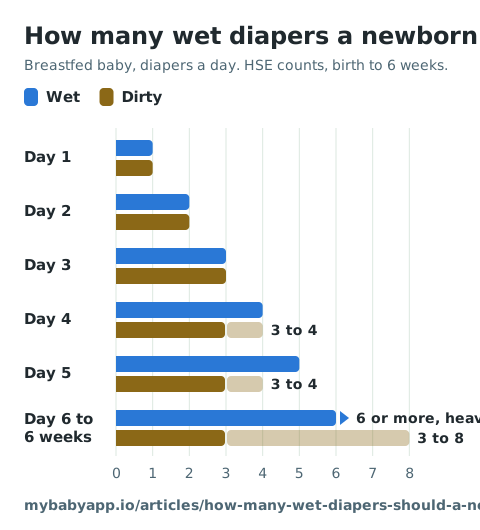
| Day of life | Wet diapers | Dirty diapers |
|---|---|---|
| Day 1 | 1 | 1, black |
| Day 2 | 2 | 2, black |
| Day 3 | 3 | 3, black or green |
| Day 4 | 4 | 3 to 4, green or yellow |
| Day 5 | 5 | 3 to 4, turning yellow |
| Day 6 to 6 weeks | 6 or more, heavy | 3 to 8, yellow and seedy |
| Formula-fed, by day 5 | Around 6, heavy | At least 1, soft |
For a breastfed baby, diapers get heavier once the milk comes in. La Leche League GB says disposable diapers should feel heavy after five full days, when plentiful milk comes in. When breast milk comes in covers the timing and the signs.
A heavy diaper is hard to judge with modern disposables. The NHS suggests adding 2 to 4 tablespoons (about 30 to 60 ml) of water to an unused diaper to feel what a wet one should be like, and La Leche League GB suggests 3 tablespoons (45 ml).
For a formula-fed baby, Unicef UK's Baby Friendly Initiative looks for around six heavy, wet diapers a day by day five and at least one soft stool a day. None of these sources gives formula-fed counts for days 1 to 4.
The AAP names weight gain, wet and dirty diapers, and how long a baby seems satisfied after nursing as good clues to whether a breastfed baby is getting enough. Come back to them if your baby feeds constantly during the 2-week growth spurt.
How many dirty diapers should a newborn have?
For a breastfed baby, one or two a day on days 1 and 2, then 3 to 4 a day by day 5 in the HSE's counts, or by 5 to 7 days in the AAP's. The AAP describes 1 or 2 blackish, tarry stools a day on days 1 and 2, at least two greenish to yellow ones on days 3 and 4, and at least 3 to 4 yellow, loose ones a day by 5 to 7 days old. The NHS sets a lower floor: from the fourth day, at least 2 soft, yellow poops a day for the first few weeks. Its general newborn page puts it at 2 or more a day in the first week.
The HSE's range for day 6 to 6 weeks is 3 to 8 poops a day, yellow, seedy and runny to loose. The AAP notes that once milk production increases, a breastfed baby will often stool with each feeding for the first month.
Formula-fed babies follow a different pattern. The AAP says a formula-fed baby should have at least one bowel movement a day, and describes their stools as usually tan or yellow, firmer than a breastfed baby's but no firmer than soft clay, and adds that green stools are not unusual either and should not cause alarm. The NHS says formula-fed babies may poop up to 5 times a day when newborn.
The change from black meconium to yellow is covered in the first 3 days of feeding.
What color should newborn pee be?
For a breastfed baby, pale yellow or nearly clear by the end of the first week. The AAP says a well-nourished breastfed newborn has nearly colorless or pale yellow urine by 5 to 7 days old, and the HSE describes pee from day 6 to 6 weeks as pale yellow or clear. La Leche League GB adds that urine should be mild smelling.
In the AAP's general newborn guidance, healthy urine is light to dark yellow, and darker urine is more concentrated, as it is when a baby is not drinking a lot of liquid. After 7 days, the AAP lists dark yellow urine among its warning signs of a breastfeeding problem.
What is brick dust in a newborn's diaper?
Brick dust is a pink or brick-red stain in the diaper in the first week after birth, which the AAP says is usually a sign of very concentrated urine. La Leche League GB calls these reddish pink crystals urates, often described as looking like brick dust, and says they should stop appearing as your baby begins to take more milk.
The AAP notes that the stain is often mistaken for blood, and that as long as your baby is wetting at least four diapers a day there is probably no cause for concern. If the pinkish staining persists, the AAP says to consult your pediatrician.
The AAP says newborn girls may have a small spot of blood in the diaper in the first week, caused by the birth parent's hormones. After that, it says, actual blood in the urine or a bloody spot on the diaper is never normal and your pediatrician should be told.
How many diapers does a newborn go through a day?
Up to 10 or 12 a day. The NHS says young babies may need changing as many as 10 or 12 times a day, and older babies around 6 to 8 times. The NHS advises changing a diaper as soon as possible after a pee or poop to help prevent diaper rash.
What changes after 6 weeks?
After about 6 weeks, breastfed babies may poop less often and go several days without one, the NHS says, and formula-fed babies who poop up to 5 times a day as newborns may drop to once a day after a few months.
Sources differ on how far it falls. The AAP says some breastfed babies have only one bowel movement a week by 3 to 6 weeks and are still normal, as long as the stools are soft and the baby is gaining weight steadily and nursing regularly. The HSE's guide for 6 weeks to 6 months gives 3 to 5 poops a day, adding that a baby may skip a day or 2.
The NHS says a baby is not constipated as long as their poops are soft, even after a few days without one. The AAP says a formula-fed baby with fewer than one bowel movement a day who seems to be straining may be constipated, and to check with your pediatrician.
When should you call your pediatrician?
- For a breastfed baby, after 7 days: fewer than 6 wet diapers and 4 stools a day, urine that is dark yellow or specked with red, or stools that are still dark rather than yellow and loose (AAP).
- You are worried about how much milk your baby is getting. The NHS says to ask for help early.
- A pink or brick-red stain keeps appearing, or there is blood in the urine or a bloody spot on the diaper after the first week (AAP).
- Bleeding comes with other symptoms, such as abdominal pain, poor feeding, vomiting, fever or bleeding elsewhere. The AAP says to seek medical attention immediately.
- Your baby seems to be in pain or distress while peeing (AAP).
- Poops look pale. The NHS says this can be a sign of jaundice and to speak to a doctor if you notice it.
- A formula-fed baby has fewer than one poop a day and seems to be straining (AAP).
- There are large amounts of blood, mucus or water in a stool. The AAP says to call your pediatrician immediately.
In the app: A diaper log that answers the paediatrician's question
Official guidance
- Health Service Executive (HSE) — How to tell if your newborn is getting enough breast milk
- NHS — Breastfeeding: is my baby getting enough milk?
- American Academy of Pediatrics (HealthyChildren.org) — How to Tell if Your Breastfed Baby is Getting Enough Milk
- American Academy of Pediatrics (HealthyChildren.org) — Baby's First Days: Bowel Movements & Urination
- American Academy of Pediatrics (HealthyChildren.org) — Warning Signs of Breastfeeding Problems
- NHS — How to change your baby's nappy
- La Leche League GB — What's in a nappy?
- Unicef UK Baby Friendly Initiative — Bottle Feeding Assessment Tool
Written by The MyBaby editorial team. How we source and review these.
MyBaby is not a medical device and does not provide medical advice, diagnosis or treatment. Always consult a qualified healthcare professional with questions about your child's health.