How Many Ounces Should a Newborn Eat? Formula and Breast Milk by Week
· 8 min read

How many ounces should a newborn eat?
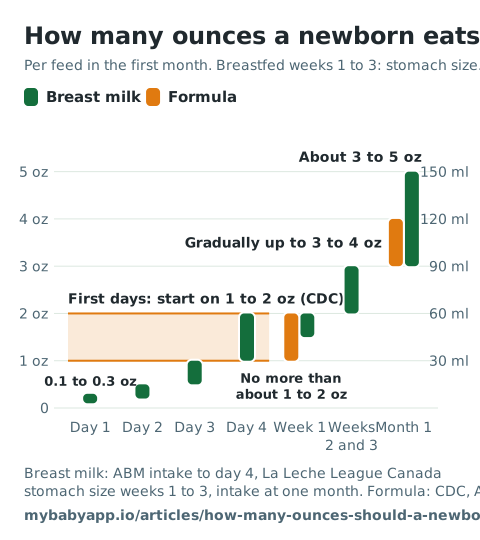
A formula-fed newborn starts on about 1 to 2 oz (30 to 60 ml) per feeding, every 2 to 3 hours in the first days, in the CDC's guidance, and works up to 3 to 4 oz (90 to 120 ml) per feeding during the first month, in the American Academy of Pediatrics' (AAP). A breastfed newborn takes less at first: the Academy of Breastfeeding Medicine (ABM) reports average colostrum intakes of 0.1 to 0.3 oz (2 to 10 ml) per feed in the first 24 hours, rising to 1 to 2 oz (30 to 60 ml) at 72 to 96 hours.
The ABM says formula-fed infants usually take in larger volumes than breastfed infants, so the two sets of figures are not interchangeable. The table keeps each body's figures separate.
| Age | Per feeding | Source |
|---|---|---|
| First 24 hours, breastfed | 0.1 to 0.3 oz (2 to 10 ml) | ABM, average colostrum intake |
| 24 to 48 hours, breastfed | 0.2 to 0.5 oz (5 to 15 ml) | ABM, average colostrum intake |
| 48 to 72 hours, breastfed | 0.5 to 1 oz (15 to 30 ml) | ABM, average colostrum intake |
| 72 to 96 hours, breastfed | 1 to 2 oz (30 to 60 ml) | ABM, average colostrum intake |
| First days, formula | 1 to 2 oz (30 to 60 ml), every 2 to 3 hours | CDC, starting amount |
| A few days old, formula | 2 to 3 oz (about 60 to 90 ml) | AAP, 2018 page |
| First week, formula | No more than about 1 to 2 oz (30 to 60 ml) | AAP |
| End of week 1, breastfed | 1½ to 2 oz (45 to 60 ml) | La Leche League Canada, stomach size |
| Weeks 2 and 3, breastfed | 2 to 3 oz (60 to 90 ml) | La Leche League Canada, stomach size |
| During month 1, formula | Gradually up to 3 to 4 oz (90 to 120 ml) | AAP |
| End of month 1, formula | At least 4 oz (about 120 ml) | AAP, 2018 page |
| One month, breastfed | About 3 to 5 oz (80 to 150 ml) | La Leche League Canada |
The AAP's two pages differ on the first days: its main formula page caps the first week at about 1 to 2 oz per feed, and its 2018 answer page gives 2 to 3 oz a few days after birth. The CDC says to give more if your baby shows signs of hunger.
The ABM figures come from its protocol on supplementing breastfed newborns, which, based on the limited research available, uses them as suggested volumes and says feedings should be based on the baby's cues. The first 3 days of feeding covers colostrum and early weight loss.
How many ounces should a 3-week-old or 1-month-old eat?
By the end of the first month, a formula-fed baby takes at least 3 to 4 oz (about 90 to 120 ml) per feeding in the AAP's guidance, and a breastfed baby takes about 3 to 5 oz (80 to 150 ml) per feeding in La Leche League Canada's figures.
In weeks 2 and 3, La Leche League Canada says a breastfed baby's stomach holds 2 to 3 oz (60 to 90 ml) at a feeding; the AAP gives no separate 3-week formula figure. If your baby suddenly wants to feed far more often, the 2-week growth spurt explains what is going on.
How much milk should a newborn drink in 24 hours?
A formula-fed baby takes about 2½ oz (75 ml) of formula a day for every pound (453 g) of body weight, on average, in the AAP's guidance, and a breastfed baby takes in about 20 to 25 oz (590 to 750 ml) a day by the end of week 3, in La Leche League Canada's figures.
The AAP says a baby should usually drink no more than an average of about 32 oz (960 ml) of formula in 24 hours. As a worked example, for an 8 lb (3.6 kg) baby that average comes to about 20 oz (590 ml) a day, though the AAP expects babies to regulate their own intake from day to day. Which water to use for making up formula has its own article.
For breastfed babies, La Leche League Canada says about 1 oz (30 ml) of colostrum is produced in the first 24 hours, and that intake reaches 750 to 1,035 ml (about 25 to 35 oz) a day at one month.
How often should a newborn eat?
About 8 to 12 times in 24 hours, for breastfed and formula-fed newborns alike, in the CDC's guidance. In the first days the CDC gives every 2 to 3 hours for formula and as often as every 1 to 3 hours for breast milk. Over the first weeks the gaps lengthen, to about every 3 to 4 hours for most formula-fed babies and every 2 to 4 hours on average for exclusively breastfed babies, some of whom cluster feed as often as every hour at times.
For a formula-fed baby who sleeps longer than 4 to 5 hours in the first few weeks and starts missing feedings, the AAP says to wake them and offer a bottle.
How much expressed breast milk should a breastfed newborn get?
No guidance body we found gives a bottle size for expressed milk in the first month. La Leche League Canada puts a breastfed newborn's stomach at 1½ to 2 oz (45 to 60 ml) by the end of week 1 and 2 to 3 oz (60 to 90 ml) in weeks 2 and 3, and La Leche League GB says most breastfed babies take about 2 to 4 oz (60 to 120 ml) of breast milk per feed between one and six months.
La Leche League GB says the amount a breastfed baby needs stays similar between one and six months, and the ABM notes that a bottle's faster flow may result in higher, and unnecessary, volumes. Paced feeding, La Leche League GB says, can help your baby control the flow and take the amount they need:
- Hold the bottle fairly horizontal, so your baby has to suck actively, as at the breast.
- Watch for signs your baby needs a break: turning away, gulping, wide eyes or splayed fingers. Tip the bottle down or take it away for a moment.
- Allow around 15 to 20 minutes for a feed, with no need to rush.
How can you tell if a newborn is getting enough?
A breastfed newborn who has had enough milk should seem content and drowsy after feeding, the CDC says. For formula-fed babies, the AAP's 2018 answer page says a baby who is growing and gaining weight, is happy most of the time and is not spitting up too much is taking the right amount for them.
The CDC's hunger signs from birth to 5 months are hands to the mouth, turning toward the breast or bottle, puckering, smacking or licking the lips, and clenched hands; crying is often a late sign. Its fullness signs are a closed mouth, the head turned away from the breast or bottle, and relaxed hands.
For formula feeds, the AAP adds that a baby who becomes fidgety or easily distracted during a feeding is probably finished, and one who drains the bottle and keeps smacking their lips might still be hungry. Diapers are the other daily check: how many wet diapers a newborn should have gives the counts by day.
What changes after the first month?
Formula feeds get bigger: the AAP's 2018 page says most babies increase their formula by an average of 1 oz a month before leveling off at about 7 to 8 oz (about 210 to 240 ml) per feeding, and its main page expects 6 to 8 oz (180 to 240 ml) at each of 4 or 5 feedings by 6 months. The newborn feeding chart lays out formula and breast milk amounts and feeds a day by age, up to 6 months. La Leche League Canada says breastfed babies need about the same amount of breast milk per day from one month to six months, and La Leche League GB notes that this is different from formula feeding, where larger volumes are often suggested as a baby grows.
Between 2 and 4 months, or once a baby weighs more than 12 lb (5.4 kg), the AAP says most formula-fed babies no longer need a middle-of-the-night feeding.
When should you call your pediatrician?
- Your baby consistently seems to want more or less than the AAP's amounts. The AAP says to discuss it with your pediatrician.
- You have questions about your baby's growth, or concerns about how much they are eating or sleeping (CDC).
- You are worried about meeting your baby's needs in the first days of breastfeeding. The CDC suggests a lactation consultant or your baby's nurse or doctor.
In the app: A breastfeeding timer that survives being interrupted
Official guidance
- Centers for Disease Control and Prevention (CDC) — How Much and How Often to Feed Infant Formula
- Centers for Disease Control and Prevention (CDC) — How Much and How Often to Breastfeed
- Centers for Disease Control and Prevention (CDC) — Signs Your Child Is Hungry or Full
- American Academy of Pediatrics (HealthyChildren.org) — Amount and Schedule of Baby Formula Feedings
- American Academy of Pediatrics (HealthyChildren.org) — How much formula does my baby need?
- Academy of Breastfeeding Medicine — ABM Clinical Protocol #3: Supplementary Feedings in the Healthy Term Breastfed Neonate, Revised 2017
- La Leche League Canada — Newborns Have Small Stomachs
- La Leche League GB — Bottles and other tools
Written by The MyBaby editorial team. How we source and review these.
MyBaby is not a medical device and does not provide medical advice, diagnosis or treatment. Always consult a qualified healthcare professional with questions about your child's health.