Newborn Feeding Chart: How Much and How Often, Birth to 6 Months
· 7 min read
How much and how often should a newborn eat, by age?
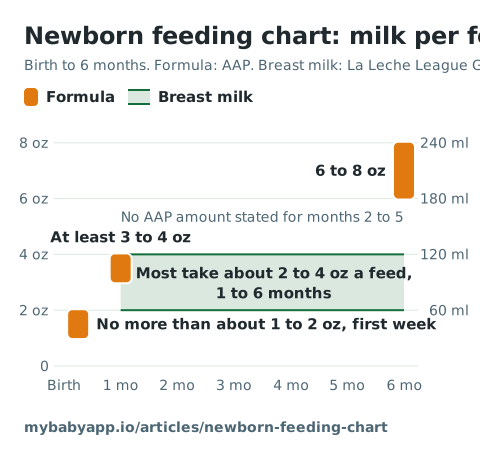
In the American Academy of Pediatrics' (AAP) guidance, a formula-fed baby takes no more than about 1 to 2 oz (30 to 60 ml) per feed in the first week and 6 to 8 oz (180 to 240 ml) at each of 4 or 5 feedings a day by 6 months. A breastfed baby feeds about 8 to 12 times in 24 hours over the first weeks and months, in the CDC's guidance, and most take about 2 to 4 oz (60 to 120 ml) of breast milk per feed between one and six months, in La Leche League GB's figures.
Formula and breast milk follow different curves. La Leche League GB says the amount a breastfed baby needs stays similar between one and six months, unlike formula feeding, where larger volumes are often suggested as a baby grows. For the first month in detail, see how many ounces a newborn should eat, week by week.
Formula feeding chart
| Age | Amount | How often |
|---|---|---|
| First days | CDC: 1 to 2 oz (30 to 60 ml) a feed | CDC: every 2 to 3 hours, 8 to 12 feeds in 24 hours |
| First week | AAP: no more than about 1 to 2 oz (30 to 60 ml) a feed | AAP: on demand at first |
| End of month 1 | AAP: at least 3 to 4 oz (90 to 120 ml) a feed | AAP: about every 3 to 4 hours |
| Month by month | AAP: about 1 oz (30 ml) more a feed each month, on average, leveling off at about 7 to 8 oz (about 210 to 240 ml) | AAP: between 2 and 4 months, most stop needing a night feed |
| By 6 months | AAP: 6 to 8 oz (180 to 240 ml) a feed | AAP: 4 or 5 feeds in 24 hours |
| Birth to 3 months | HSE: about 2.3 oz per lb (150 ml per kg) a day | HSE: 6 to 8 feeds a day, every 3 to 4 hours |
| 4 to 6 months | HSE: about 2.3 oz per lb (150 ml per kg) a day | HSE: 4 to 6 feeds a day, every 4 to 6 hours |
The last two rows come from the HSE, Ireland's Health Service Executive, which gives a daily amount by body weight instead of a bottle size. The AAP gives no age for its 1 oz a month.
Breastfeeding chart
| Age | How often | Breast milk per feed |
|---|---|---|
| First days | CDC: as often as every 1 to 3 hours | HSE, first week: most full-term babies take no more than 0.2 to 2 oz (5 to 60 ml) |
| First weeks and months | CDC: about 8 to 12 times in 24 hours; most exclusively breastfed babies every 2 to 4 hours on average | HSE, from 4 to 5 weeks: about 3 to 4 oz (90 to 120 ml) |
| 1 to 2 months | Nemours KidsHealth: 7 to 9 times a day | La Leche League GB, 1 to 6 months: about 2 to 4 oz (60 to 120 ml) |
The HSE and La Leche League GB give different per-feed figures from the second month, and both say the amount then stays about the same until 6 months.
How much formula does a baby need in 24 hours?
A formula-fed baby takes about 2½ oz (75 ml) of formula a day for every pound (453 g) of body weight, on average, in the AAP's guidance, and should usually drink no more than an average of about 32 oz (960 ml) in 24 hours. The HSE gives about 2.3 oz per pound (150 ml per kilogram) of body weight a day, from birth to 6 months.
The AAP adds that formula-fed babies will probably regulate their intake from day to day, so let your baby tell you when they've had enough: one who becomes fidgety or easily distracted during a feeding is probably finished.
How often does a breastfed baby feed, by age?
A breastfed baby feeds about 8 to 12 times in 24 hours over the first weeks and months, and most exclusively breastfed babies feed every 2 to 4 hours on average, in the CDC's guidance. Nemours KidsHealth says that by 1 to 2 months a baby will probably nurse 7 to 9 times a day.
The CDC says a baby may feed as often as every hour at times, often called cluster feeding, or may have a longer sleep interval of 4 to 5 hours. The 2-week growth spurt explains the days when feeds bunch together, and how many wet diapers a newborn should have is the daily check that milk is going in.
How much breast milk does a baby take per feed?
Most breastfed babies take about 2 to 4 oz (60 to 120 ml) of breast milk per feed between one and six months, La Leche League GB says, and the HSE puts a baby fed only breast milk at about 25 oz (750 ml) a day between 1 and 6 months.
The HSE says a breastfed baby's intake usually stays about the same between months 1 and 6, though it may increase during growth spurts. To size a bottle of expressed milk, the HSE suggests dividing 750 ml by the number of feeds in 24 hours: for a baby who feeds 8 times, that is about 3 oz (94 ml) per feed.
What does a newborn feeding schedule look like?
A newborn feeding schedule starts on demand and settles into longer gaps: the AAP says to feed a formula-fed newborn on demand at first, and Nemours KidsHealth says breastfeeding in the first few weeks should be on demand, about every 1½ to 3 hours.
- First weeks and months: the CDC says most formula-fed babies feed about every 3 to 4 hours.
- First few weeks, formula: if your baby sleeps longer than 4 to 5 hours and starts missing feedings, the AAP says to wake them and offer a bottle.
- Newborns, breastfed: Nemours KidsHealth says newborns should not go more than about 4 hours without feeding, even overnight.
- 2 to 4 months, formula: the AAP says that between these ages, or once a baby weighs more than 12 lb (5.4 kg), most no longer need a middle-of-the-night feeding and may occasionally go up to 4 or 5 hours between daytime feedings.
As newborns get older, Nemours KidsHealth says, they nurse less often and may have a more predictable schedule.
What changes at 6 months?
At around 6 months, solid foods start alongside milk: the HSE says you can start weaning your baby onto solid foods at around 6 months, and the AAP recommends breastfeeding as the sole source of nutrition for about 6 months.
From 6 to 12 months, the CDC says most babies need infant formula or solid foods about 5 to 6 times in 24 hours and gradually need less formula as they eat more solids. The HSE says breast milk intake begins to decrease gradually after 6 months, and the CDC calls breast milk the most important source of nutrition even after solids start. How much milk a baby needs after starting solids picks up from here.
When should you call your pediatrician?
- Your baby consistently seems to want more or less formula than the AAP's amounts. The AAP says to discuss it with your pediatrician.
- You have concerns about how much your baby is sleeping or eating, or questions about their growth or how much breast milk they are getting. The CDC says to talk to their doctor or nurse.
- Your baby takes a lot less or a lot more formula than the HSE's daily amount. The HSE says to talk to a public health nurse or GP.
In the app: A breastfeeding timer that survives being interrupted
Official guidance
- American Academy of Pediatrics (HealthyChildren.org) — Amount and Schedule of Baby Formula Feedings
- American Academy of Pediatrics (HealthyChildren.org) — How much formula does my baby need?
- Centers for Disease Control and Prevention (CDC) — How Much and How Often to Feed Infant Formula
- Centers for Disease Control and Prevention (CDC) — How Much and How Often to Breastfeed
- HSE (Health Service Executive, Ireland) — Preparing baby formula
- HSE (Health Service Executive, Ireland) — How much breast milk to express
- La Leche League GB — Bottles and other tools
- Nemours KidsHealth — Breastfeeding FAQs: How Much and How Often
Written by The MyBaby editorial team. How we source and review these.
MyBaby is not a medical device and does not provide medical advice, diagnosis or treatment. Always consult a qualified healthcare professional with questions about your child's health.